Three Principles of an Effective Manager
When I recall my first experience as a manager of a team with 16 people, the term overwhelming falls short. I found myself lacking the confidence and training I knew would be required to succeed. I discovered a trove of literature containing pieces of knowledge, experience, and wisdom which explores specific aspects of both leadership and management. I eventually found answers to the questions I had been rumbling with since that first day.
Identifying, crafting, and articulating an appropriately phrased question is the most valuable skill we can develop. We expand our knowledge and build our skills by asking questions and creating repetition [1]. To illustrate this, effective negotiators ask a question for every five comments they make [2]. Asking an engaging question in the right moment will yield insightful answers and fuel continued curiosity. As I gained the skills to navigate the nuance of balancing the needs of people and the needs of a business, I stumbled on the following simple yet surprisingly elusive question: How do I become an effective manager?
Imagine the role models who set the implicit gold standard for which we might aspire to. Are there specific approaches or techniques they use which are different from others? What do these people think, and how do they act? How do they navigate our complex world of human emotion and the nuance of social interactions? How do they handle the acute and chronic pressures that build in a business setting? As we consider these questions, another fundamental question requires an answer.
What is an effective manager?
As an engineer, I began my leadership journey by searching for a process or established method that would help guide my actions and decisions as a manager. In this search, I was surprised to discover the following simple definition, “leadership is the art of getting people to want to do what must be done” [3]. Leadership is a form of art; this is a keen observation by General Eisenhower, and it has changed my perspective. Ultimately, a manager conducts a team of individuals who must deliver meaningful outcomes, because each person wants to do it! I now recognize a single unified process does not exist, and there is fluidity of structure and behaviors used across many successful managers and teams. There is at least one common thread that spans this spectrum. Team members who share the values of cohesive teamwork and collaboration create the foundation of a thriving organization. Building mutual trust and understanding amongst teammates sets the cornerstone of that foundation [4]. In lieu of an “ultimate process,” I identified the following common themes shared by several bodies of peer-reviewed research published in the field of behavioral psychology.
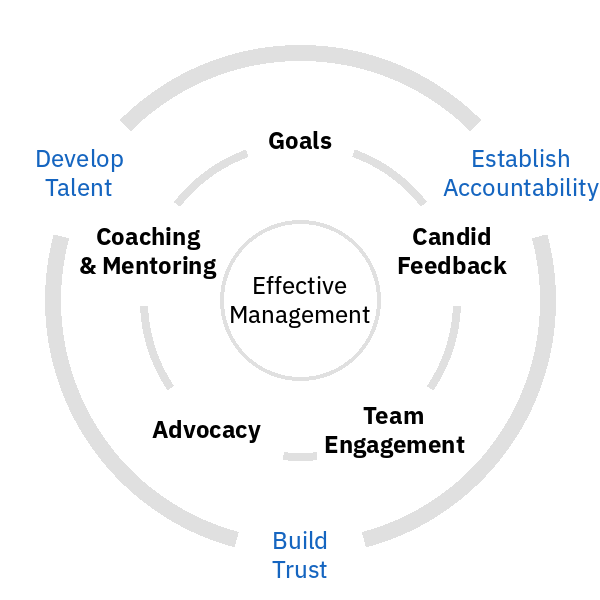
An effective manager ensures the long-term success of the employees they serve by acting concordantly with the following core principles of leadership:
- Build trust by developing personal relationships.
- Develop talent by inspiring growth.
- Establish accountability for the team and its members to ensure successful outcomes.
A manager must tailor an implementation of these principles to both their specific leadership style and the needs of their business. The following five dimensions of humble leadership can help us shape our individual practices and develop recurring habits which embody these core principles. Balancing effort across these five dimensions will give a manager the best chance of success:
-
Goals – establishing and reviewing goals on a regular basis is a useful practice to adopt with every individual on a team. Clear and concise goals representing a shared responsibility between the employee and manager will improve accountability, engagement, and motivation. An employee’s goals are grounded by the shared objectives of the whole team and organization. Learning the “one-minute goal” method published by Ken Blanchard is a great place to get started [5].
-
Candid feedback – the art of providing meaningful and actionable feedback is essential for helping others flourish. This spans the full spectrum from encouragement and praise to corrective action and intervention. There are substantial resources available for how to approach these conversations and how to tailor each encounter for a specific person [6] [7]. Moreover, it is important to understand how a complete organization operates. Collecting feedback from team members and across organizational boundaries will bridge visibility gaps and provide insight to grasp the complete picture of each team member’s contributions.
-
Coaching and mentoring – the practice of coaching and mentoring others for growth provides one of the most important methods for inspiring others to improve themselves. The G.R.O.W. model published by John Whitmore is a useful technique managers can apply when coaching others because it helps people take responsibility for their own development [8] [9].
-
Advocacy – understanding and internalizing an employee’s needs and wants is essential to helping them achieve their desires [10] [11]. These needs and desires can then be reframed in the context of the organization and business needs to ensure mutual alignment and ownership of common goals. When advocating for people, “the rare individual who unselfishly tries to serve others has an enormous advantage” [12]. Showing a genuine interest in each individual a leader serves will yield great benefits for everyone.
-
Team engagement – intentional interactions with a team both individually and together will forge strong bonds, foster good will, and create an essential foundation of trust. These can span the spectrum of activities from informal individual conversations to department meetings and team outings [13].
Following this leadership framework will, “help people feel purposeful, motivated, and energized so they can bring their best selves to work” [14]. Figure 1 below represents the relationship between the three core principles and the five dimensions of leadership.
Maximizing recurring habits
Establishing regular habits, routines, and tasks which contribute to each of the five dimensions will allow a manager to achieve a harmonious balance across the three core principles of leadership mentioned above. The recurring activities worksheet table included below provides a simple framework for mapping these dimensions to a manager’s specific responsibilities.
| Dimension | Activity | Frequency |
|---|---|---|
| Goals | Define and agree on roles and responsibilities | ad-hoc |
| Establish and revise "one-minute" goals | bi-monthly | |
| Coaching | Schedule frequent informal check-ins to facilitate a natural coaching and feedback mechanism | semi-monthly |
| Ask open-ended questions with the G.R.O.W. model | ad-hoc | |
| Advocacy | Discuss professional aspirations and identify paths for growth | semi-annually |
| Team Engagement | Request input to understand organizational gaps and possible areas for improvement | quarterly |
| Candid Feedback | Catch people doing something right! Provide informal appreciation for a job well done [5] |
ad-hoc |
The following questions provide a starting point for this activity.
- What are the recurring and ad-hoc actions required for my success?
- Which of these activities are the most important?
- How frequently must I perform each one?
- Which dimension does each activity fulfill?
Sustaining Personal Growth
Reflection is a simple, cheap, and effective practice that fuels enduring personal growth. We all can recall situations, encounters, or events that we wish happened differently.
In the wake of these experiences, we often do not ask ourselves the questions which will help us process, move through, and then learn from events that transpired [2]. Most people do not spend enough time considering how each experience may affect us, and how we might affect others. Reflection should also be applied after positive encounters to help us lean into our strengths. Embracing self-reflection is an essential process for maintaining a grounded perspective and sustainable personal growth [15]. When reviewing the outcome of each recurring activity listed above, ask the following questions: what mistakes did I make, what worked well that I should continue, and what lessons can I learn from the experience [12]?
The only way for us to see a more complete view of ourselves is through the practice of reflection. We all have imperfections and blemishes we prefer to cover or hide. Self-reflection helps us hold up a mirror to ourselves, but this does not show us every angle. We must also adopt the habit of seeking the perspective from other trusted individuals, so they may enlighten us with our faults and mistakes. Additionally, and equally as important, these people help us celebrate our achievements, and they provide meaningful encouragement [1]. This recurring practice will continue to build mutual trust between team members and fortify the foundation of every team!
Everyone has the capacity to grow over time, and our individual and collective potential has no clear boundaries. The overwhelming majority of people want to perform well, and they will strive to reach their full potential when supported properly [16]. Adopting a regular habit of reflection will help us all feed our innate desire to achieve greatness.
* * *
The role of a manager is complicated and unique to every setting. Focusing on building trust, developing talent, and establishing accountability helps fortify the foundation of a strong and productive team. The essence of effective management occurs in the moment, and there are many techniques available to improve a team’s effectiveness. We must recognize when it’s time to deepen a relationship, encourage creativity, or hold someone to a higher standard. These micro decisions compound over time, and they yield tremendous benefits; usually when you least expect it.
Works Cited
[1] B. Brown, dare to lead, Penguin Random House, 2018; pgs. 175, 22.
[2] A. Grant, Think Again, Penguin Books, 2021; pgs. 105, 3.
[3] B. L. Jim Collins, BE 2.0, Penguin Random House, 2020; pg. 43.
[4] P. M. Lencioni, The Five Dysfunctions of a Team, Jossey-Bass, 2002; pg. 40.
[5] K. Blanchard and S. Johnson, New One Minute Manager, Harper Collins, 1983; pgs. 27, 39.
[6] M. Valcour, “How to Give Tough Feedback That Helps People Grow,” Harvard Business Review, [Online]. Available: https://hbr.org/2015/08/how-to-give-tough-feedback-that-helps-people-grow.
[7] D. Dowling, “Giving Effective Feedback When You’re Short on Time,” Harvard Business Review, 16 Feb 2015. [Online]. Available: https://hbr.org/2015/02/giving-effective-feedback-when-youre-short-on-time.
[8] J. Whitmore, Coaching for Performance: GROWing People, Performance and Purpose, Nicholas Brealey, 2002.
[9] G. Bill and Z. Clayton, “Successful Leaders Are Great Coaches,” Harvard Business Review, [Online]. Available: https://hbr.org/2022/10/successful-leaders-are-great-coaches.
[10] S. G. Rogelberg, “Make the Most of Your One-on-One Meetings,” Harvard Business Review, Nov 2022. [Online]. Available: https://hbr.org/2022/11/make-the-most-of-your-one-on-one-meetings.
[11] Harvard Management Update, “Communicating Strategically with Direct Reports,” Harvard Business Review, 27 Feb 2008. [Online]. Available: https://hbr.org/2008/02/communicating-strategically-wi.
[12] D. Carnegie, How to Win Friends and Influence People, 1936; pgs. 42, xxvi.
[13] M. Zakhour and C. N. Hadley, “The Surprising Power of Team Rituals,” Harvard Business Review, January 2025. [Online]. Available: https://hbr.org/2025/01/the-surprising-power-of-team-rituals.
[14] D. Cable, “How Humble Leadership Really Works,” Harvard Business Review, [Online]. Available: https://hbr.org/2018/04/how-humble-leadership-really-works.
[15] L. Wiseman, “Acing Your Self-Appraisal,” Harvard Business Review, [Online]. Available: https://hbr.org/2023/03/acing-your-self-appraisal-even-if-its-your-first.
[16] P. Cappelli and A. Tavis, “The Performance Management Revolution,” Harvard Business Review, October 2016. [Online]. Available: https://hbr.org/2016/10/the-performance-management-revolution.